← SELECTED WORK

02 / 03 · FINAL-YEAR COMPUTER-SCIENCE PROJECT

AI AGENT SUPPORT CLASSIFIER

A support-triage system combining deterministic checks, structured AI analysis and explicit human-approval gates.

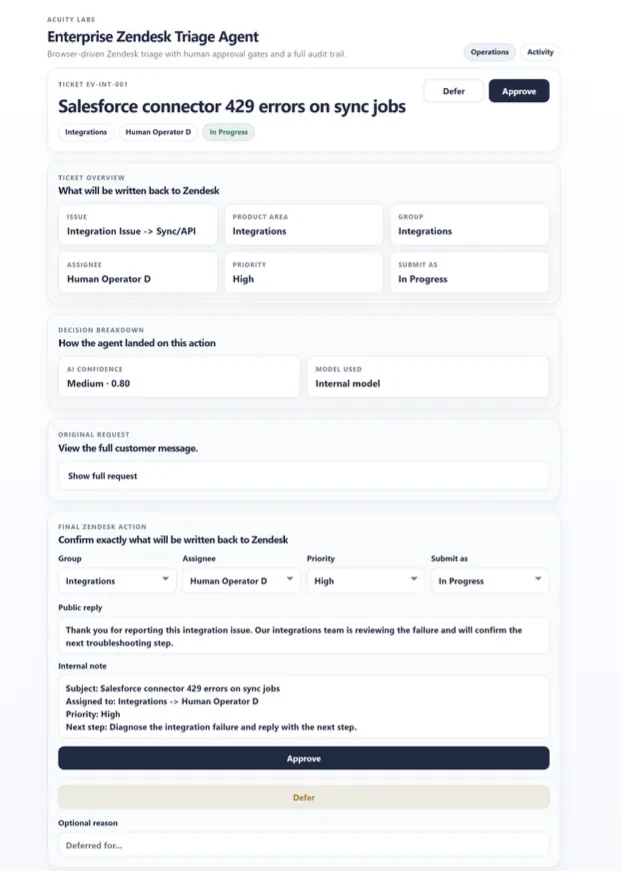
Ticket review screen with routing decision, confidence breakdown and editable reply
HUMAN-APPROVAL CONSOLE · SANDBOX WORKSPACE · FIG. 7
STATUS
Completed · working artefact + 67-page dissertation
ROLE
Sole author · system, evaluation, dissertation
CONTEXT
Final-year project (COMP390) · University of Liverpool
TIMELINE
2025 / 26
PLATFORM
Python · Zendesk

01 · AT A GLANCE

  1. 01

    Sole author of the full system: agent, policy engine, operator console, test suite and dissertation.

  2. 02

    Deterministic-first design: the LLM is consulted only on seven explicit ambiguity triggers, and every write into Zendesk is verified by re-reading it.

  3. 03

    Evaluated honestly: 100% route accuracy on the eight-case labelled sandbox suite (n = 8), with 75% of cases routed to human review by design.

STATUS
Completed final-year project
ROLE
Sole author · system, evaluation, dissertation

02 · SYSTEM DEMONSTRATION
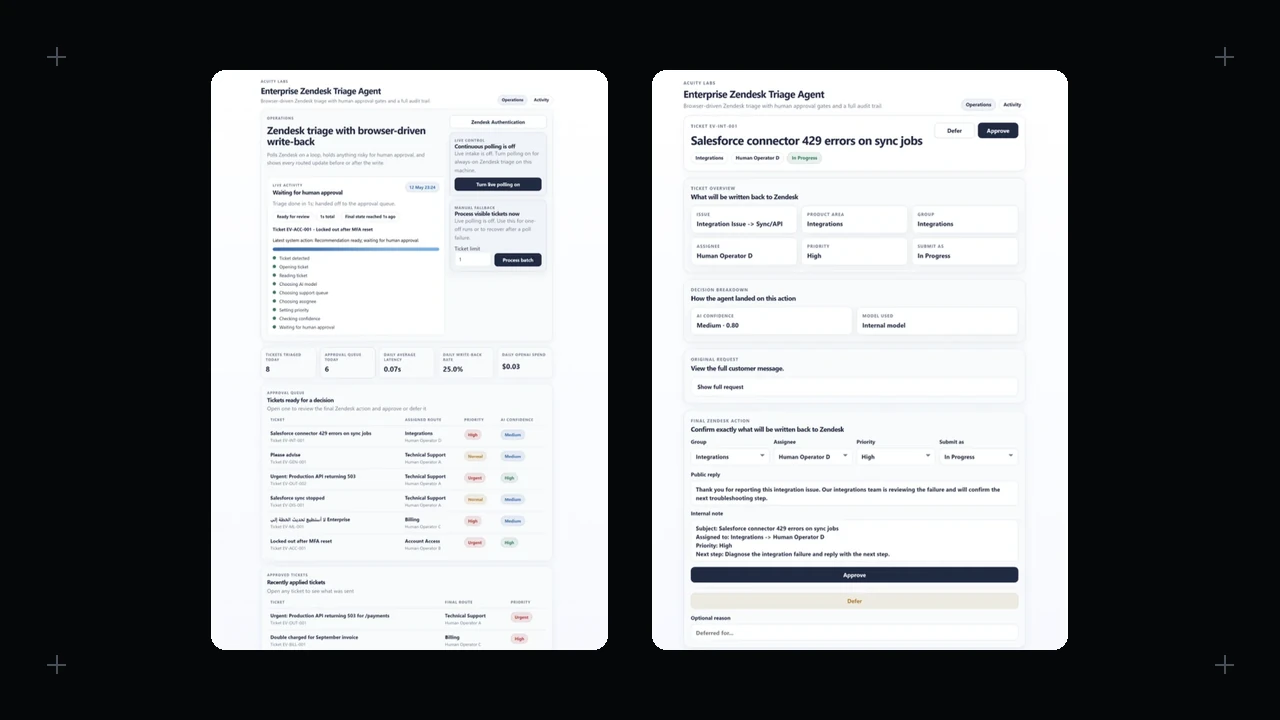
Both operator console screens of the triage system on a dark frame
Recorded demonstration: the system reading a live Zendesk view, classifying, and writing verified updates back, with the operator console approving low-confidence work. · LOADS YOUTUBE ON CLICKWATCH ON YOUTUBE ↗

03 · THE PROBLEM

Support triage decides which queue, owner and priority every ticket gets, and mis-routing has asymmetric cost: an outage misfiled to billing compounds in a way the reverse does not. Automating that decision is only acceptable if every risky path fails toward a human.

04 · THE SYSTEM

My final-year project operates a real Zendesk workspace through a Playwright-driven browser. It reads each ticket, scores it against seven intent profiles with a transparent confidence formula, and consults a structured-output LLM only when one of seven ambiguity triggers fires. Anything below the automation threshold waits in a human approval console with a per-reason explanation. I am the sole author of the system, the evaluation and the 67-page dissertation.

05 · KEY DECISIONS

  1. 01

    Deterministic first

    The failure modes of a pure LLM router are hard to audit, so the LLM is consulted only when one of seven explicit ambiguity triggers fires.

  2. 02

    One shared contract

    A 36-line route-critical contract is shared by the classifier and the policy engine, so safety logic cannot drift between stages.

  3. 03

    Verified write-back

    Every write into Zendesk is re-read before a ticket counts as triaged, and low-confidence work waits in a human approval console with a per-reason explanation.

06 · VERIFICATION AND OUTCOME

Measured on the eight-case labelled sandbox suite (n = 8) · stub-mode latency.
Route accuracy100%
Urgent precision / recall100% / 100%
Execution reliability100%
Median latency0.139s

75% of cases were routed to human review. That is a safety decision, not a failure: six of the eight cases were built to require it.

Formula
conf = 0.40·intent + 0.20·urgency + 0.30·routing + 0.10·execution
Thresholds
Auto-apply ≥ 0.86 · consequential ≥ 0.91 · LLM review < 0.72 · high-impact < 0.82
Degraded mode
If the LLM is unavailable, confidence caps at 0.74, below every auto-apply threshold, so every fallback ticket waits for a human.
Latency
Heuristic path 20 to 35ms · LLM round-trip 700 to 1,500ms · browser write + verify 2 to 8s
Scale
5,561 lines of Python · 47 tests across six modules · 36-line shared routing contract

CONSTRAINTS, EVALUATION & LIMITS

  • The evaluation proves the safety gates refuse correctly, but n = 8 cannot prove generalisation.
  • Latency was measured in stub mode. Live LLM round-trips add 700 to 1,500ms per consultation.
  • Sandbox Zendesk workspace, not production traffic, volume or adversarial input.
  • English-language tickets only.